
With 2026 still being fresh and several 2025 reports being published, it’s a good time to reflect on what has happened in 2025 in the cloud native space. Below are some observations from the space. The numbers and data come from the following sources:
- Cuemby’s State of Cloud Native 2025 report
- CNCF State of Cloud Native Development Q3 2025
- CNCF Technology Radar
- State of FinOps 2025 Report
Table of Contents
- The Integration of AI in Cloud Native Environments
- Hybrid and Multi-Cloud are no longer optional
- Advancements in Observability and Financial Operations
- Security as a Core Priority
- Expanding Adoption and Technological Shifts
- Persistent Challenges
- Outlook for 2026
The Integration of AI in Cloud Native Environments
A prominent development in 2025 was the deepened integration of artificial intelligence (AI) and machine learning (ML) into cloud native architectures. This evolution progressed from conceptual stages to widespread practical deployment. AI workloads on Kubernetes became prevalent, accompanied by advancements in vector databases and inference tools. See The Symbiotic Revolution: AI and Cloud Native Technologies Transforming the Digital Landscape for more thoughts and examples on how the two subjects have integrated. Tools such as Apache Airflow demonstrated effectiveness in orchestrating ML processes, and NVIDIA Triton received the highest ratings when it comes to AI inferencing tools and engines. When it comes to developers, 41% of professional ML/AI developers state that they are cloud native.
Hybrid and Multi-Cloud are no longer optional
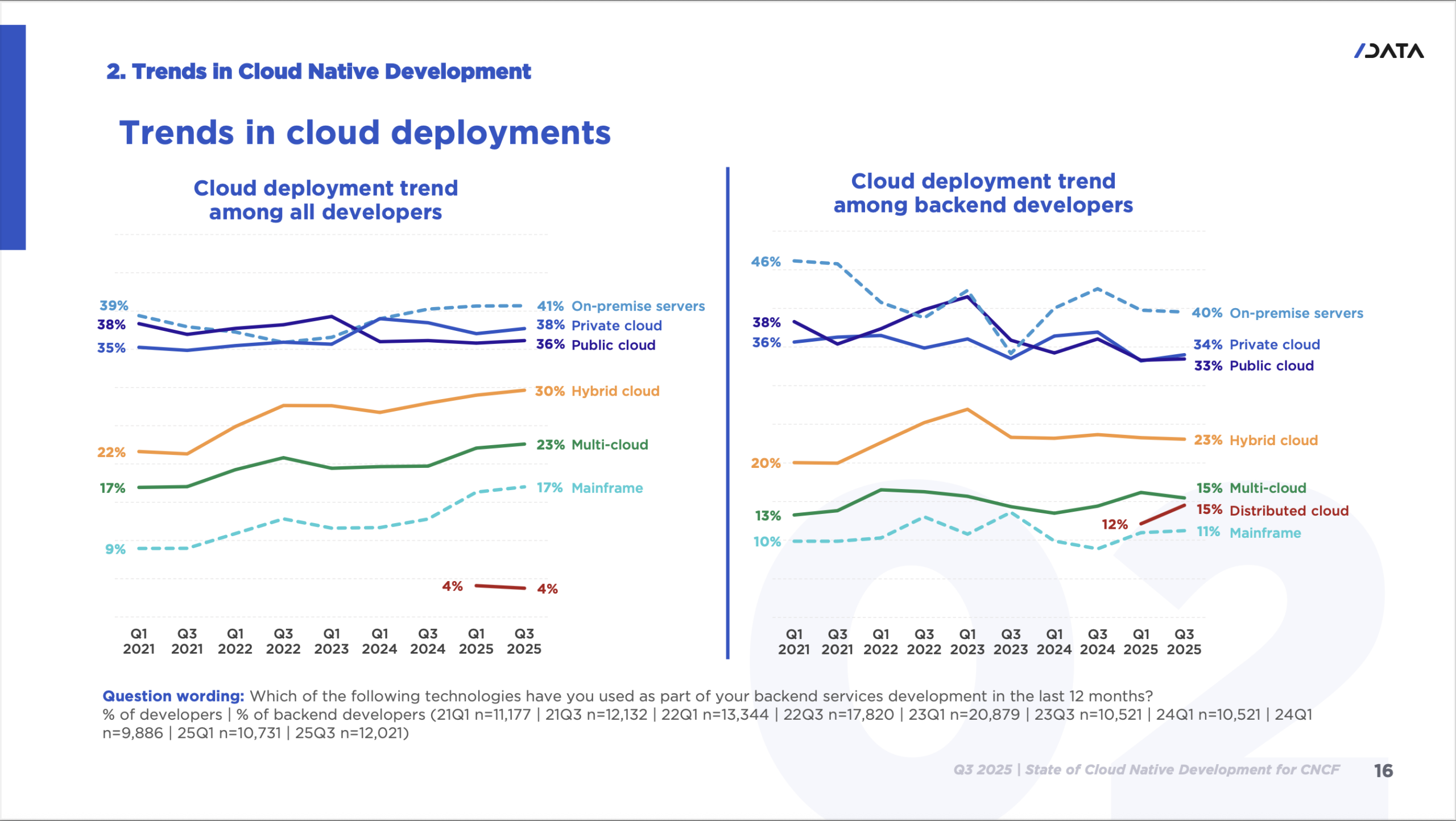
Hybrid and multi-cloud configurations continue to rise in 2025. These approaches provided flexibility, with adoption rates at approximately 30% for hybrid and 23% for multi-cloud among backend developers. Nevertheless, public and private cloud deployments, as well as on-premises servers, still hold the upper hand. Distributed cloud setups also increased to 15%.
Advancements in Observability and Financial Operations
Observability frameworks saw substantial improvements in 2025. Outages, averaging $2 million per hour in costs for major incidents, necessitated full-stack observability, which frequently halved expenses. Tool usage consolidated, reducing from nearly six to under four on average. Financial operations (FinOps) advanced, with 63% of teams tracking AI expenditures—a marked rise from prior periods. Kubernetes cost management posed challenges for 42%, yet AI-driven optimizations aided 92% of organizations.
Security as a Core Priority
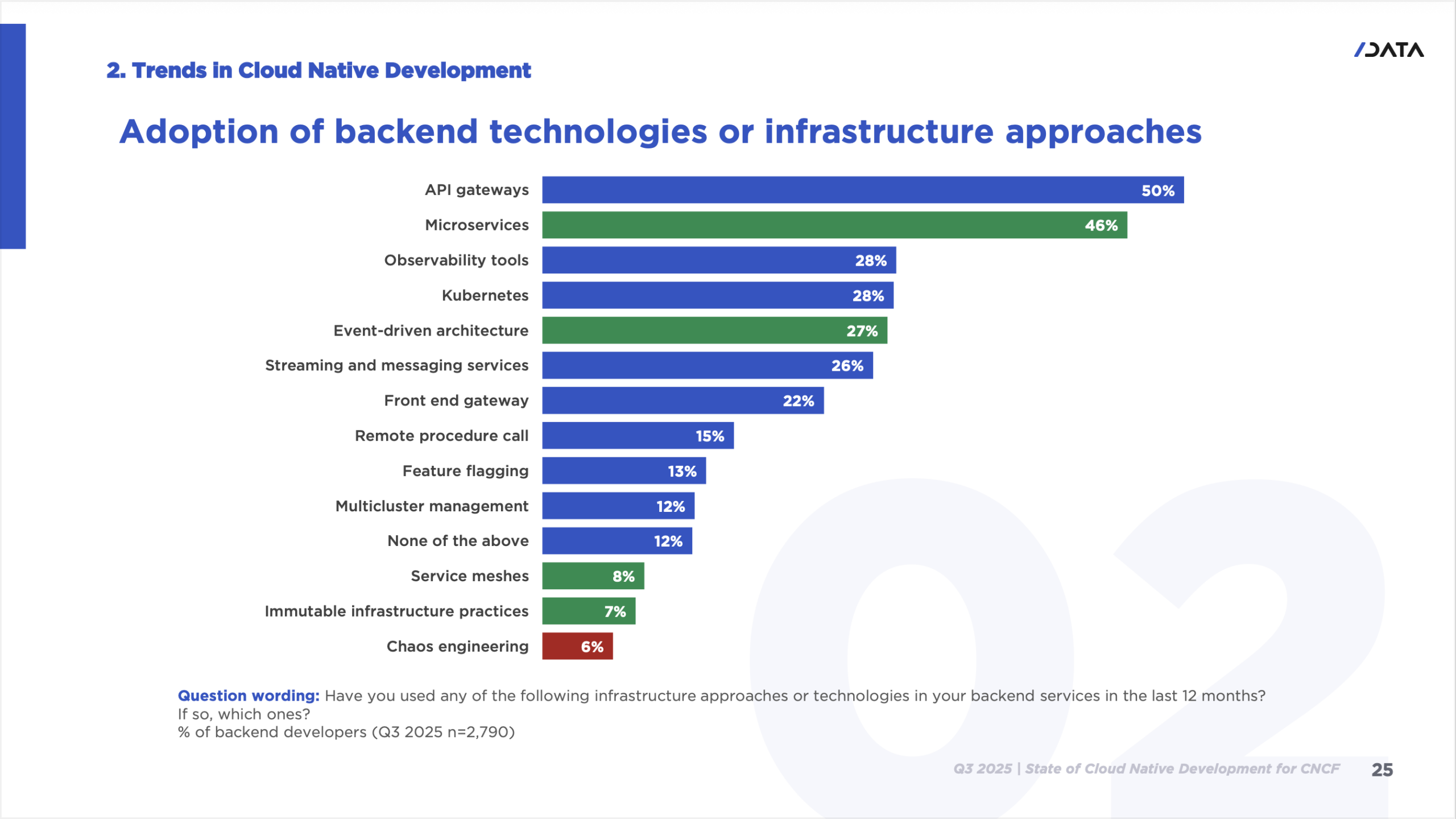
Security retained its status as a primary focus, noted by 42% of stakeholders amid rising complexities. With 78% of Kubernetes hosts on supported versions, efforts concentrated on compliance and resilience. Practices like immutable infrastructure and chaos engineering, adopted at 6-7%, are expected to expand in response to distributed threats. Database integrations with service meshes persisted, despite adoption falling to 8% due to new abstractions. These measures contributed to enhanced trust in cloud native systems.
Expanding Adoption and Technological Shifts
Cloud native adoption broadened significantly, with 56% of backend developers aligning with the paradigm—up from 49%—representing about 15.6 million professionals worldwide. Key elements included API gateways at 50% and microservices at 46%, while Kubernetes stabilized at 30%, reflecting maturity. Serverless and event-driven architectures gained traction, alongside low-code/no-code tools that democratized access.
Persistent Challenges
Despite progress, 2025 presented obstacles. Cost optimization continued to pose difficulties, with 88% of organizations reporting increases in total cost of ownership. Adoption varied across sectors, such as gaming at 30%, highlighting disparities, and advanced methodologies lagged in implementation. Sustainability also gained prominence as a key consideration in deployment strategies.
Outlook for 2026
In summary, 2025 represented a period of consolidation for cloud native technologies, establishing them as foundational elements in modern computing. Looking toward 2026, I anticipate further advancements in AI integration, edge computing innovations, and a heightened focus on sustainability.