No, it’s not. It’s actually much more than that.
I know there have been a lot of talks, blogs, etc. around AI promising it to be all sorts of things and you might think that this is just another one of those noise-generating posts – but hear me out on this one.
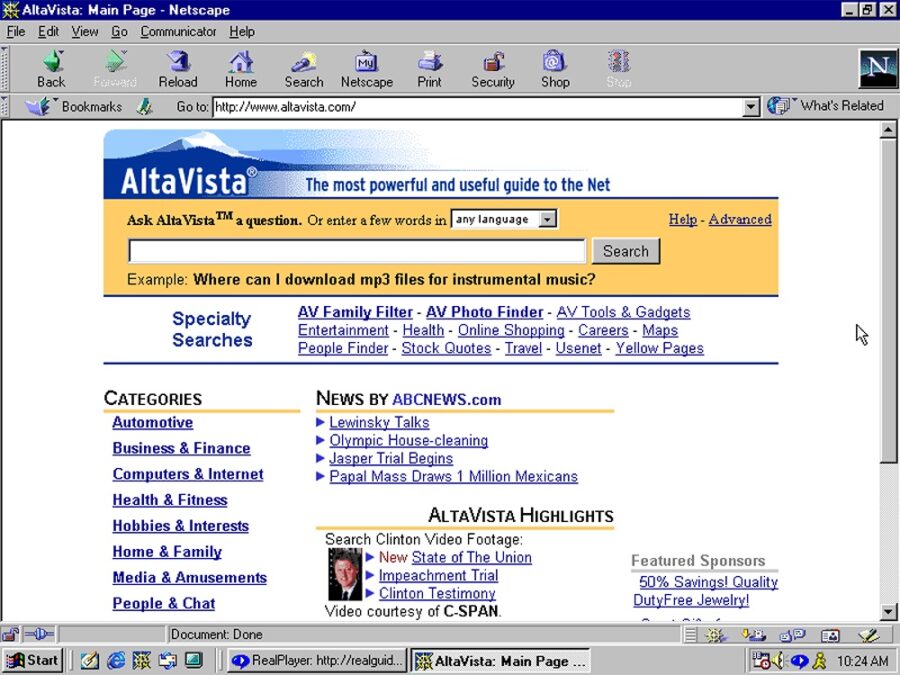
I was around when the Internet came about, and in the beginning, it sucked. It was so bad that nobody really knew why you would want to use the Internet, dialing up with your 28k modem that made weird noises, and when finally done, all you got were a bunch of crappy, mostly plain sites that took forever to load, and that you could do absolutely nothing with. Really, thinking back to those days, I think most people just had what was back then famously called a “homepage”, a page on the Internet that talked about you in a few sentences and maybe you had a picture of yourself there too. But you couldn’t do anything with these pages, and there was not much else. The Internet was slow. The Internet was clucky. And people couldn’t even begin to understand that this will one day impact, if not replace, newspaper stands, bookshops, conferences, and so much more. The early days of the Internet were horrendous, and for most, it was impossible to envision what linking up a bunch of computers to view some random homepages would do to the world going forward.
But look at the Internet now. It has become ubiquitous. Nowadays, you expect to have Internet just as you expect to have electricity. When I was around 10 and wanted Internet too, my parents were like, “Do you really need this Internet thing? It doesn’t do anything.” It took several years for me to get an Internet connection for my home computer, and it wasn’t cheap back then either. Nowadays, when you move house, you sign up for water, electricity, and Internet without even thinking twice about it. The Internet has become a utility like electricity and water. And you have it not only at home, but you have it anywhere, even in your pocket, thanks to your smartphone. Most people now have Internet all the time, and really nobody uses it anymore just to browse a friend’s homepage. Instead, we really use it for everything: for road navigation with real-time updates, to order stuff on Amazon via a click of a button to have it delivered the same day, or to video call some loved ones on another continent and speak to them like they were just across the table, banking, learning, etc. The Internet is pretty darn cool, and living without it would be hard to imagine nowadays. Just ask anybody younger than 25.
Now, where am I going with this? Well, right now, I hear a lot of people being very critical about AI, and I get it. There is a lot of praise out there for what AI will do for us and a lot of examples of where AI gets it (sometimes totally) wrong. Some people say it will change the world in ways we can’t even imagine, others claim it’s just another hyped up thing for Silicon Valley people to get rich from. To me, this all feels a lot like the early days of the Internet. Two years ago, when the hype started, there wasn’t much you could do with AI. Yes, there were some pretty cool demos of a few LLMs that could run some nice predictions of something or generate a piece of trivial code. Soon after, everybody claimed some sort of “We do AI too”. Many IT companies suddenly had AI offerings (and yet often lacked an AI strategy). The hype built quickly and broadly. Some say it’s like the dot-com bubble, and others think it’s like 10 times the dot-com bubble. But none of this behavior is new. I have seen this over and over again when a new hype or trend appears. I saw it with Hadoop, with NoSQL, with Blockchain (and many more that died so fast again, they don’t even deserve to be mentioned). First, people claim that this (new thing) will fundamentally change the world, and then the critics pop up and try to poke holes wherever they can.
Sounds familiar? It’s happening again right now. But I think AI is different, well, except that here too the critics have settled in. I have been in too many conversations where folks share their experiences with ChatGPT and Co and casually dismiss it because “I cannot do everything with it (like having it read my emails or create PowerPoint presentations), therefore I’m better off just sticking to the way I used to do things” or the much more annoying “Well, I asked it one question but the answer it came up with was wrong”. There is a strange thing happening with AI. People expect it to be perfect and are using examples of imperfection to dismiss it entirely. I don’t get it. Why would we expect that AI is bulletproof and, you know, perfect? In my 25 years in the IT industry, I haven’t seen anything that was perfect. Software still has bugs and needs patching. Developers implement features that are far from the original requirements. Even just communication between humans is mediocre at best. In how many meetings have you been where you say or ask something just to be completely misunderstood by the other folks? For all of these scenarios, we have the right expectation. Software will have bugs and will require patches, which is why we create patching schedules. Requirements change or expand, hence why we have regular check-ins to validate the progress and/or adjust the course. And meetings, well, somehow the corporate world convinced itself that having lots of meetings is where the productivity lies, instead of clear directions and goals, and letting people get on with actually doing stuff. But with AI, we somehow expect it to be magically on point every single time, although nobody ever claimed that it would be. Is it job security fear, or is it “I don’t want to learn anything new” fear? Probably a combination of both and more.
AI is the new Internet. So what do I actually mean by that? Why is AI different than Hadoop, and what made the Internet different than these other hypes? What makes a hype not a hype? Good question, but let me ask you something. Where do you think we will be in five years from now? How did we get from 28K modems, AltaVista search pages, and crappy homepages to streaming movies in high definition on phones as if it always has been that way? I joined Oracle in 2012, just around when the Hadoop hype started. Back then, people were like, “Oh man, this will revolutionize the data warehousing industry”. Entire companies were created that tried to capitalize on the hype, and I’m sure some of them did. In the end, however, Hadoop didn’t bring the said revolution. I have witnessed the Blockchain hype, too! Blockchain disappeared even faster than Hadoop (the hype, not the technology). But what made the Internet different than these two hypes? What makes a hype a hype and what doesn’t? When you compare the three, the Internet has a consumer applicability. Hadoop and Blockchain are two technologies that address technical problems. Hadoop is an implementation of some Google papers that talked about how to aggregate massive amounts of data, while Blockchain is a technology that securely decentralizes control over data. Both of them are great technologies, but they are not very applicable to everyday humans. Remember when I said that now we navigate traffic and order stuff from our couch thanks to the Internet? That’s pretty universally applicable. You don’t have to be a computer genius to do it. On the contrary, you have to know nothing about computers at all to use them, and millions of people prove that every day over and over again. AI has the same universal applicability. I, for one, have stopped googling for everyday life stuff. Instead, I ask AI (the free Claude app on my iPhone). Whether it’s to get a sense of what kind of fruit I’m looking at or how to prepare something.

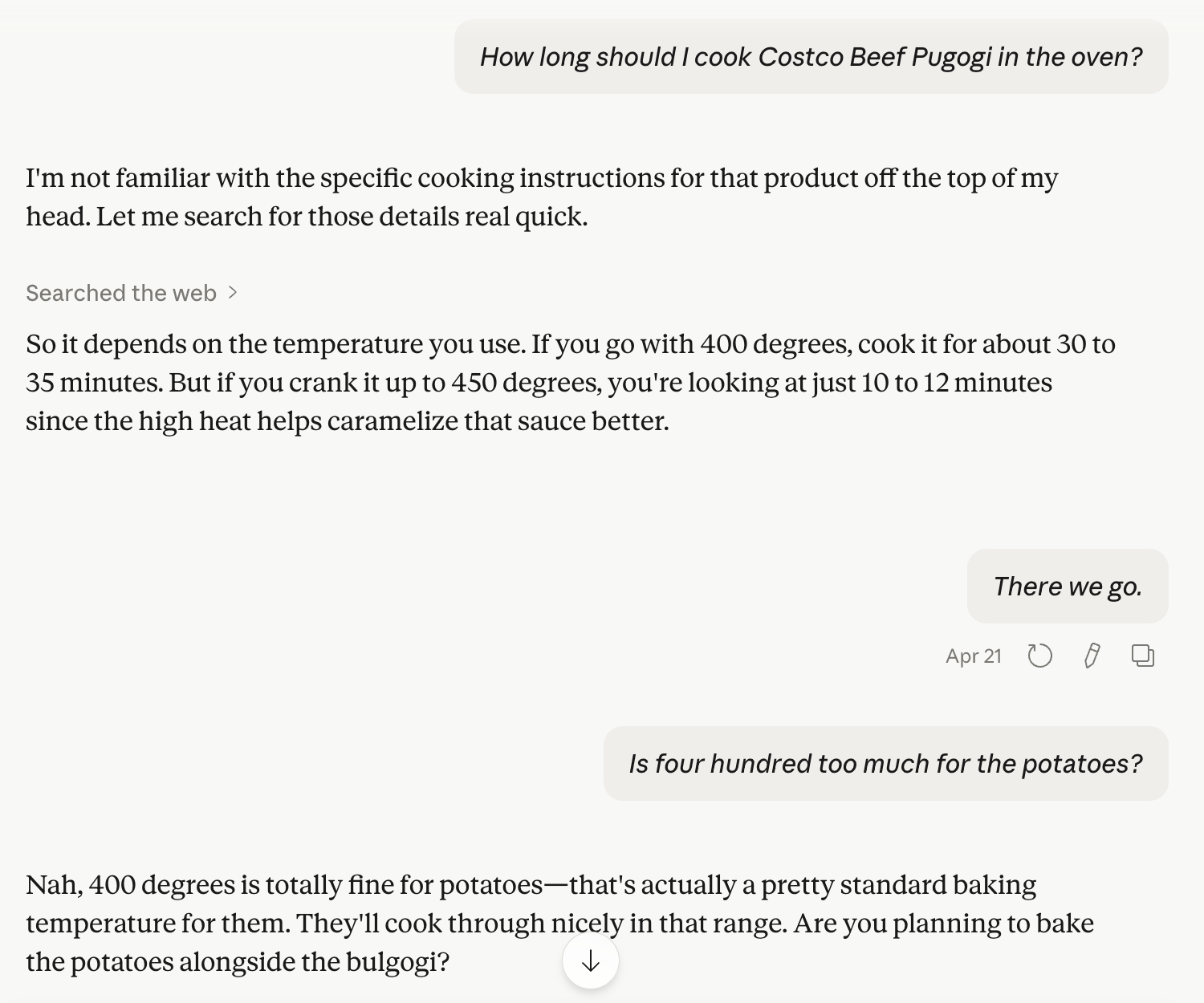
I ask it and I get a response. I read that response and form my own opinion on it. If it misunderstood, I clarify my question. If I have another question, I just ask it. And if I want a third opinion, I toss the same question over to ChatGPT and see what it says. It’s not that different than asking some friends about their opinion. Will I get the perfect answer? Maybe, maybe not. Will I get a wrong answer, perhaps, but that’s why I ask multiple friends, not just one. Having a conversation with AI is not that different than what we do every day, having a conversation with other human beings. But that’s not the game changer. The game changer is the speed at which you get an answer. You can ask your friends, you can call them up, or drive to them, or perhaps you are lucky enough to already be in the same room. But ask them about what fruit that is, they may know off the top of their hat, or they have to go and Google it themselves. In the end, they will provide me with their answer (right or wrong), but with AI, I have the same outcome in a matter of seconds. It’s not that different for developing apps either. What will sometimes take days or even months to think about, design and write, you can now generate in a couple of minutes without even having to worry about the what or how something is done. What I mean by that is that you no longer have to create your classes, read up on which library function to call, remind yourself how to parse a file line by line, etc. Not that anything of that is wrong or bad, and of course, your mileage will vary depending on whether you do this every day or haven’t written such code in months. But with AI, it doesn’t matter anymore; it’s instant gratification. I tell it what I want, it analyzes what I told it to do and in a couple of minutes, I have something. Will it be perfect? Most definitely not. But guess what, I just tell it what it did wrong or what else I want it to do and it does it. It’s again the same as talking to a colleague, except that what would take a meeting, some hours or days for the developer to write, me to try out and then talk again about what did go wrong or else I want, with AI I can do this within 10 minutes.
It’s truly a game changer and just having seen all the things that changed in the last couple of months, what we can do now versus what we could just do, heck, even just a year ago, it’s incredible. AI is not the new Internet; it’s like the new Internet on steroids. It has the potential to change everybody’s life, and it has already started. I have a friend in the car sales industry. He tells me that dealers started to feed customer complaints through ChatGPT for a response. They gave the response the name Lucy (changed). People replied to the sales manager with praise for Lucy because she was so attentive to what bothered them. My wife had to send a formal email in Italian and really couldn’t be bothered writing it. I told her, “Don’t write it, just tell Grok via the microphone”. She did, in Italian, and was amazed to say the least. It was a 2-minute conversation and she was done.
Anybody in the world with an Internet connection and a device connected to it can use Google Maps to navigate, video call their friends, look after their finances, read up on what’s happening in the world, order something from the store, etc. The Internet is no longer something we can envision living without. It makes life just so much easier, more convenient and often faster. It has become a utility just like water and electricity. AI has the very same potential; everybody can use it for any question they have, as if they were talking to another human being. But instead always having a conversation with someone who has a vast knowledge of many things. AI isn’t a hype; it won’t go away. It makes life easier for everyone. It may not be perfect, it may be clunky, but we are not done yet and this is only the beginning. Just like the Internet, companies will continue to push the boundaries of what it can be used for. And one day, for our kids, or their kids, AI will be as if it was always there, just like the Internet is today…