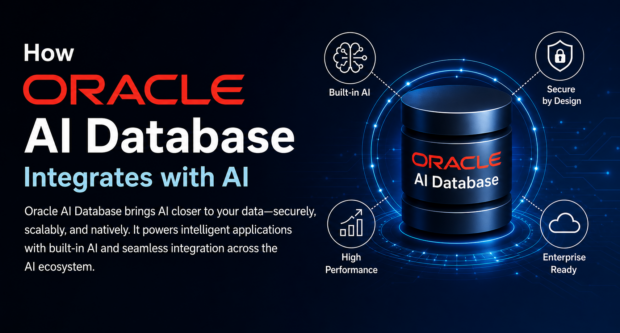
Enterprise AI is rapidly changing how organizations think about databases, data platforms, and application architecture.
Until now, AI systems have been built on fragmented stacks where transactional data lived in relational databases, embeddings were stored in separate vector databases, metadata was stored elsewhere, and governance had to be layered on top of each component. While this worked for MVPs and small-scale environments, it creates major operational and architectural challenges at enterprise scale.
Oracle AI Database takes a fundamentally different approach by integrating AI capabilities directly into the database platform itself.
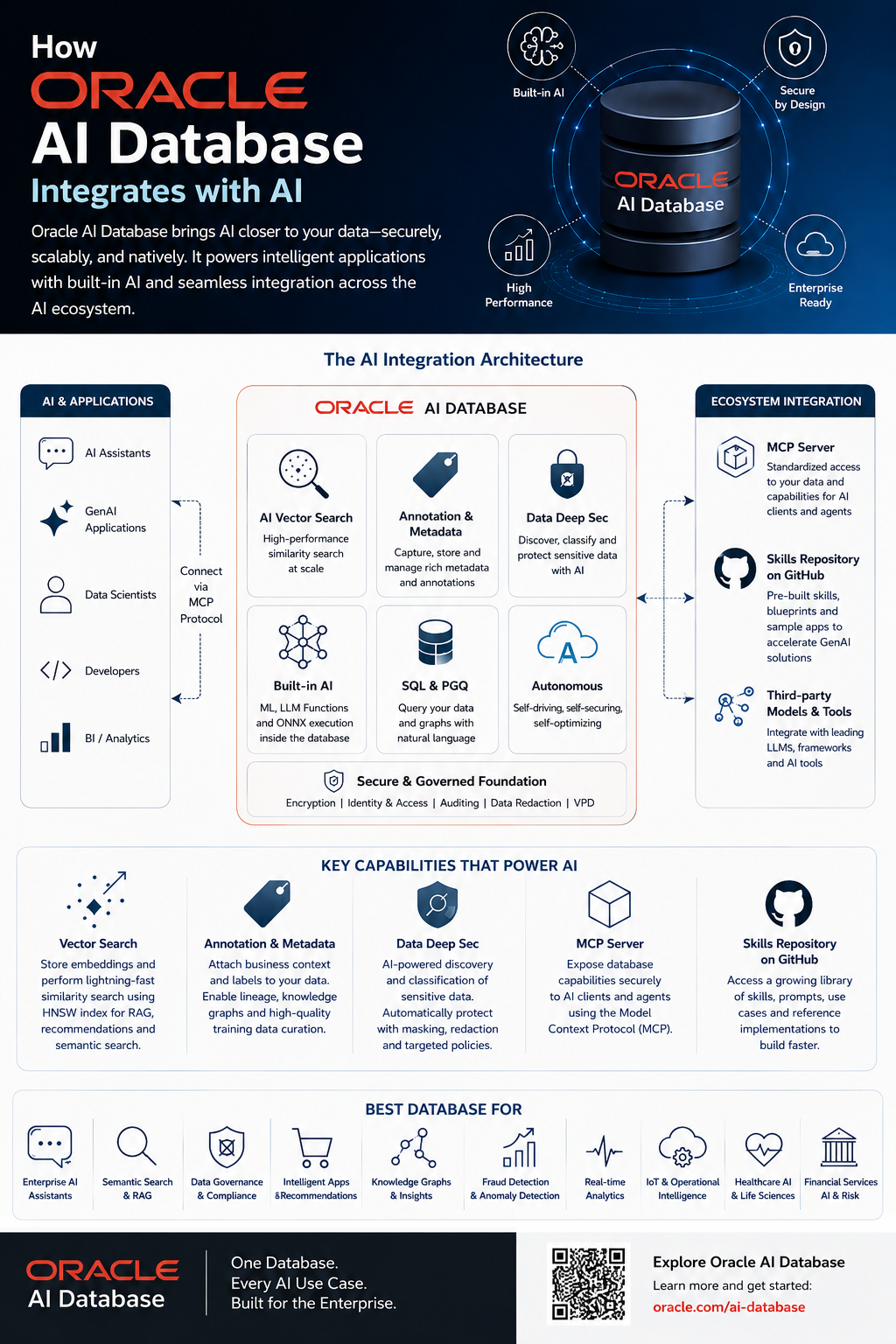
Instead of treating AI as an external service bolted onto enterprise infrastructure, Oracle converges vector search, metadata management, graph analytics, AI inference, governance, and agent connectivity into a unified architecture. The database becomes more than a storage layer — it becomes the foundation for enterprise AI systems.
Key Capabilities provided by Oracle AI Database
- ✅ Unified architecture for relational, vector, graph, and AI workloads
- ✅ Native support for RAG, semantic search, and AI agents
- ✅ Integrated governance, metadata, and security controls
- ✅ Reduced complexity compared to fragmented AI stacks
AI Vector Search + Enterprise Context
One of the most important capabilities is native AI Vector Search. Modern AI applications rely heavily on Retrieval-Augmented Generation (RAG), semantic search, and contextual retrieval. Oracle allows embeddings to be stored directly alongside enterprise data while enabling high-performance similarity search using optimized indexing structures like HNSW.
What makes this especially powerful is that vector retrieval does not happen in isolation. Enterprise AI systems rarely need “vector-only” queries. Real-world workloads combine semantic similarity with filtering and aggregation, apply domain knowledge, determine graph relationships, and adhere to security policies.
For example, an enterprise AI assistant may need to retrieve semantically similar documents related to a customer account, filter them by regulatory classification, apply row-level security, and rank results based on metadata trust scores — all in real time. What seems a common, simple user request quickly becomes a major data integration challenge for an isolated technology stack. Oracle takes a different approach by executing these operations inside a single database engine.
Why This Matters
- Combines vector similarity with SQL filtering and graph traversal
- Enables secure enterprise-grade semantic retrieval across all data
- Reduces latency and infrastructure sprawl
- Simplifies RAG application architecture
Why Metadata & Annotations are important
Another area that deserves attention is Oracle’s annotation and metadata functionality. One of the biggest challenges in enterprise AI is not simply retrieving data, but understanding the context around said data. Metadata becomes critical for lineage, explainability, governance, semantic enrichment, and reducing hallucinations in AI systems.
By integrating annotations and metadata directly into the platform, Oracle enables organizations to build AI systems that are more trustworthy, more explainable, and significantly easier to govern.
Metadata Advantages
- Improves AI explainability and trust
- Enables governance-aware retrieval
- Supports lineage and provenance tracking
- Enhances RAG quality and hallucination reduction
AI Security & Deep Data Security
Security is an area where Oracle’s architecture always stood out. Naturally, AI workloads are no exception.
AI introduces entirely new governance concerns around sensitive data exposure, prompt leakage, unauthorized retrieval, and compliance enforcement. Oracle’s Deep Data Security capabilities bring AI-aware security and governance directly into the database platform through automated discovery, classification, masking, redaction, and policy enforcement.
This is important because many AI architectures unintentionally bypass traditional governance models when data is copied into external AI systems or standalone vector databases. Oracle keeps governance centralized and embedded into the retrieval and inference pipeline itself.
Security Highlights
- Centralized governance for AI workloads
- Built-in masking, redaction, and classification
- AI-aware access controls and policy enforcement
- Reduced risk of sensitive data exposure
MCP Servers & Agentic AI
The MCP server integration is particularly interesting from an architectural perspective.
Model Context Protocol (MCP) has emerged as the standardized way for AI agents and applications to securely access tools, enterprise systems, and contextual data sources. Oracle AI Database can expose governed database capabilities directly through MCP, enabling AI agents to interact with enterprise data securely and dynamically.
This transforms the database into an active participant within agentic AI ecosystems rather than simply acting as passive storage.
MCP Benefits
- Standardized connectivity for AI agents
- Secure access to enterprise data and tools
- Simplified orchestration for agentic AI systems
- Better interoperability across AI platforms
Accelerating AI Development
Oracle is also accelerating developer adoption through its Skills Repository on GitHub, which includes reusable AI patterns, reference implementations, MCP integrations, RAG blueprints, and enterprise AI examples. This helps organizations reduce implementation complexity and standardize AI architectures across teams.
Developer Benefits
- Faster enterprise AI implementation
- Reusable AI integration patterns
- Reference architectures for RAG and agents
- Simplified onboarding for AI development teams
Why This Architecture Matters
What makes Oracle AI Database strategically important is the convergence happening underneath the platform.
The enterprise AI stack is evolving toward unified systems that combine relational processing, vector search, graph analytics, metadata intelligence, governance, and AI inference into a single architecture. Oracle is one of the few enterprise platforms with the vision to bring all of these capabilities together cohesively, and the only one that has already delivered on it with the latest release of Oracle AI Database 23.26.2.
The future of enterprise AI will not be built on disconnected systems. It will be built on platforms that can combine secure enterprise data, semantic understanding, contextual metadata, AI governance, and autonomous agent interoperability at scale.
That is the direction Oracle AI Database is moving toward.
Final Thoughts
- Oracle AI Database is a unified, converged AI platform
- Enterprise AI requires secure, governed contextual retrieval
- Metadata and vectors are equally important for AI quality
- MCP and agent interoperability will become foundational
- Oracle AI Database is positioned at the very center of this evolution